

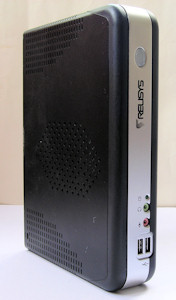
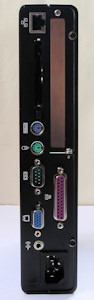
The underlying hardware is a Teco TR3230F. It is also marketed as an Itium 2920 from a French Company, Impact Technologies. My example was manufactured in March 2005.
The basic specs are:
Processor Type
SpeedSiS 550
250MHzMemory Flash
RAM32Mb
64Mb (max 512Mb?)Video Chip
Max resolutionSiS550
16000 x 1200 16-bit colourPorts Network
USB
Serial
Parallel
PS/210/100
2 x USB1.1
1
1
Kybd & mousePower Off
Idle
Running1W
9W
11WDimensions W x H x D 15.5cm x 24cm x 5cm
The Relisys RWT205CE runs Windows CE Pro 5. The unit was manufactured in March 2005. It's manufactured by Teco. and has a model number of TR3230. Back in 2011 Teco's website showed a TR3541 which is very close in physical appearance.
I photographed this in the vertical position (despite the orientation of the logo) as a label on the side of the unit suggests it should be used in this orientation.
For those to whom it matters here is some detail from Linux's /proc/cpuinfo
vendor_id : SiS SiS SiS cpu family : 5 model : 0 model name : 05/00 stepping : 5 flags : fpu tsc cx8 mmx cpuid
00:00.0 Host bridge: Silicon Integrated Systems [SiS] 550 Host (rev 01)
00:00.1 IDE interface: Silicon Integrated Systems [SiS] 5513 IDE Controller (rev d0)
00:01.0 ISA bridge: Silicon Integrated Systems [SiS] SiS85C503/5513 (LPC Bridge)
00:01.2 USB controller: Silicon Integrated Systems [SiS] USB 1.1 Controller (rev 07)
00:01.4 Multimedia audio controller: Silicon Integrated Systems [SiS] SiS7019 Audio Accelerator
00:02.0 PCI bridge: Silicon Integrated Systems [SiS] AGP Port (virtual PCI-to-PCI bridge)
00:0b.0 CardBus bridge: Texas Instruments PCI1410 PC card Cardbus Controller (rev 01)
00:0d.0 Ethernet controller: Realtek Semiconductor Co., Ltd. RTL-8100/8101L/8139 PCI Fast Ethernet Adapter (rev 10)
01:00.0 VGA compatible controller: Silicon Integrated Systems [SiS] 550 PCI/AGP VGA Display Adapter
The Relisys RWT205CE has an internal power supply with a conventional IEC-style mains connector.
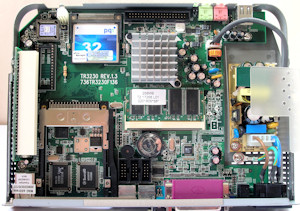
Flash: The Flash memory in the Relisys is a Compact Flash card - which makes it trivial to replace with a larger card and alternative operating system. It can be seen at the top left in the picture.
Ram: The RAM is a conventional 64Mb PC-133 144-pin SO-DIMM. As you can see in the photograph I have replaced this with a 256MB SO-DIMM with no problems. I do not know what the maximum is that the socket supports but the literature on the Itium 2920 gives it as 256MB.
IDE: Looking at the circuit board you can see to the right of the CF card a 40-pin IDE connector. I have not tried to use this as I already have various flavours of Linux pre-installed on Compact Flash cards. However Mario from Romania has connected a CDROM drive to it and booted a variety of operating systems including Windows 95, 98, ME and 2k.
Serial: Behind the keyboard and mouse sockets are three 10-pin sockets. Checking with a meter I found -9V on some of the pins. The dmesg output from Puppy shows that four serial ports were found so I guess these are the three additional serial ports.
PCMCIA: There is a PCMIA slot.
PCI:There is a small riser card (on the left in the photo) and space for a single pci card to be fitted.
In April 2022 I heard from Robin who was trying to use a sound card in the PCI slot. He had noticed that the RWT205CE motherboard (a TECO TR3230F) was similar to the one used in the Fujitsu Siemens S200 (a TECO TR5670). He checked and discovered that, like the S200, there was no +12V supply on the PCI backplane. He followed the S200 Mods guide to add a 12V supply.